
-3.png)
-3.png)
Accurate emissions inventories, faster: AI Emissions Match plus supplier-scale coverage
Ready to shift from compliance to competitive advantage?
Book a demo and see how SINAI can help you streamline data, meet requirements, and build stakeholder trust.

Today, sustainability teams are blocked by the operational grind: messy data, template-heavy work, manual mapping, and supplier follow-up that never scales. That friction makes every inventory cycle feel like reinventing the wheel.
SINAI’s latest release strengthens the Measure and Engage modules, which are built to eliminate operational friction in measurement. AI Emissions Match ingests unstructured data across Scopes 1–3 without templates, using a Data Match Agent to accelerate mapping to a broad emissions factor ecosystem, including supplier-specific emission factors. The result is faster reporting with fewer errors.
Enterprise emissions data is messy by default
In practice, emissions inputs arrive as procurement exports, AP and ERP extracts, logistics files, and utility bills. Columns drift. Units are inconsistent. Context sits in notes. Teams lose weeks translating real company data into the rigid formats many carbon accounting tools can ingest. Many platforms still treat ingestion as template compliance: fill out a CSV template, then upload it. That turns the hardest part of carbon accounting into formatting work, not measurement, and even less so targeted action.
The truth is that generic automation claims won’t fix this. The bottleneck is ingestion, mapping, and calculations at enterprise scale, with governance that traces every number back to source activity data and the emission factor used.
That is why we built AI Emissions Match to deliver speed and accuracy across the board: accept messy, unstructured inputs without rigid templates, then map them to best-fit factors through a reviewable workflow that standardizes results across cycles.
AI Emissions Match is the ingestion and mapping engine across Scopes 1–3
SINAI’s AI Emissions Match is designed for messy enterprise data:
- Ingest real-world operational files without templates
- Interpret structure and fields, including units and context
- Map to best-fit emission factors, with review workflows to validate, standardize, and reuse mappings over time
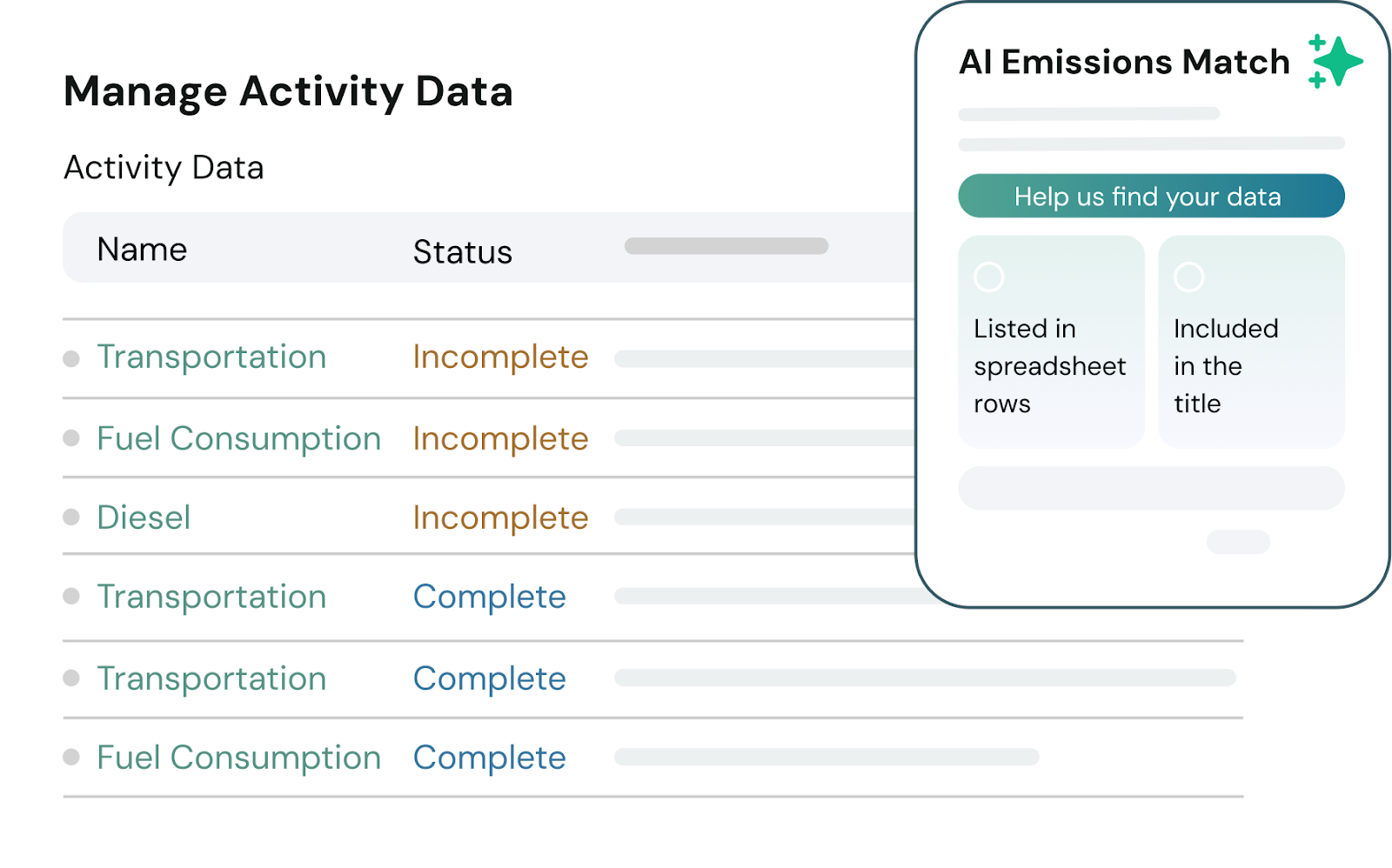
AI Emissions Match now includes a Data Match Agent that automatically detects and classifies columns, interprets units and context, and matches line items to best-fit emission factors. Teams can then review and bulk-edit mappings to standardize results and speed every reporting cycle.
Driving accuracy across Scopes 1–3
Accuracy doesn’t come from a better formula. It comes from reducing real-world error drivers: inconsistent source files, unit confusion, duplicate entries, missing context, and mismatched emission factors. Many tools still require teams to reshape enterprise exports into rigid templates before calculations can run. That is busywork and introduces risk precisely where you need defensibility.
AI Emissions Match improves accuracy at the point of failure: ingestion and mapping. By standardizing messy inputs into activity records, reducing manual transformation, and consistently mapping the right activity to the right emission factor, SINAI cuts avoidable errors. The result is clearer provenance and more consistent year-over-year calculations across all scopes.
Faster inventory cycles across Scopes 1–3
Most teams don’t “measure once.” They measure on a recurring cadence: baseline builds, monthly rollups, quarterly cycles, annual reporting, and ad-hoc updates when business activity changes. Speed matters because inventory is only useful if it can be refreshed at your business's pace.
AI Emissions Match compresses inventory cycle time by removing the template bottleneck. It ingests real-world files, detects and interprets structure (columns, units, dates, context), and accelerates emission factor matching through a governed review workflow.
The result is materially less manual mapping and faster closes: enterprise teams can reduce manual mapping and data entry by ~25–50%, depending on footprint complexity, and in highly repetitive datasets, reductions can be as high as 75%.
Emission factor breadth as the multiplier for AI matching
AI matching is only as valuable as the emission factors behind it. When coverage is thin, teams end up with inaccurate (and overestimated) calculations. That creates delays, inconsistency, and premature supplier outreach when teams aren’t ready to run it at scale.
SINAI backs AI Emissions Match with broad emission factor coverage, including:
- 100K+ built-in emission factors, plus custom emission factors
- Major public and premium datasets: ecoinvent, US EPA, US EEIO, IPCC, UK DEFRA, AGRIBALYSE
- 4M+ global supplier-specific emissions factors to improve supplier-level specificity and reduce supplier chasing
This breadth helps teams reach completeness quickly, then improve accuracy and granularity over time as better inputs become available.
Why accurate, audit-ready Scope 3 matters now and how supplier-specific factors support it
Scope 3 is where inventories get politically and operationally hard. It typically accounts for the largest share of emissions, yet spans a value chain you do not control. For Category 1 Purchased Goods and Services, the minimum boundary includes all upstream (cradle-to-gate) emissions associated with those goods and services. The same ingestion and governance requirements apply across Scopes 1–2, but Scope 3 is where completeness and specificity are most challenging to operationalize.
Disclosure expectations are raising the bar on repeatability and transparency. ESRS E1 requires companies to update Scope 3 emissions for each significant category annually, using current activity data, and to disclose the percentage calculated from primary supplier or value chain partner data, including the methods and tools used.
Sustainability leaders need operational workflows they can run every reporting cycle, not a one-time estimate. Supplier-specific emission factors support the maturity curve by reducing supplier chasing for the long tail: teams can build a complete baseline faster with supplier-linked specificity where available, then prioritize deeper supplier engagement only where primary data materially improves results and reporting quality. For Scope 3, that translates into a maturity curve you can actually run without turning sustainability teams into supplier-chasing operations.
How SINAI accelerates accurate, complete emissions inventories
The core problem in enterprise carbon accounting is not whether you can calculate emissions. It’s about whether you can consistently close accurate, granular inventory on a real cadence, with governance that meets disclosure expectations and is appropriate for enterprise operations. SINAI makes this practical across Scopes 1–3: no-template ingestion for messy enterprise data, faster cycles, and more accurate mapping, powered by broad and supplier-specific coverage of emission factors.
- Use AI Emissions Match to ingest and standardize activity data across Scopes 1–3 without templates.
- Map quickly with broad coverage of emission factors and supplier-specific factors to avoid supplier bottlenecks.
- Prioritize deeper supplier engagement for top emitters where primary data matters most.
- Carry standardized mappings forward so the next refresh is faster and more consistent.



.jpg)



'%3e%3cg id='Final-Copy-2_2_' transform='translate(1275.000000, 200.000000)'%3e%3cpath class='st0' d='M7.4,12.8h6.8l3.1-11.6H7.4C4.2,1.2,1.6,3.8,1.6,7S4.2,12.8,7.4,12.8z'/%3e%3c/g%3e%3c/g%3e%3c/g%3e%3cg id='final---dec.11-2020'%3e%3cg id='_x30_208-our-toggle' transform='translate(-1275.000000, -200.000000)'%3e%3cg id='Final-Copy-2' transform='translate(1275.000000, 200.000000)'%3e%3cpath class='st1' d='M22.6,0H7.4c-3.9,0-7,3.1-7,7s3.1,7,7,7h15.2c3.9,0,7-3.1,7-7S26.4,0,22.6,0z M1.6,7c0-3.2,2.6-5.8,5.8-5.8 h9.9l-3.1,11.6H7.4C4.2,12.8,1.6,10.2,1.6,7z'/%3e%3cpath id='x' class='st2' d='M24.6,4c0.2,0.2,0.2,0.6,0,0.8l0,0L22.5,7l2.2,2.2c0.2,0.2,0.2,0.6,0,0.8c-0.2,0.2-0.6,0.2-0.8,0 l0,0l-2.2-2.2L19.5,10c-0.2,0.2-0.6,0.2-0.8,0c-0.2-0.2-0.2-0.6,0-0.8l0,0L20.8,7l-2.2-2.2c-0.2-0.2-0.2-0.6,0-0.8 c0.2-0.2,0.6-0.2,0.8,0l0,0l2.2,2.2L23.8,4C24,3.8,24.4,3.8,24.6,4z'/%3e%3cpath id='y' class='st3' d='M12.7,4.1c0.2,0.2,0.3,0.6,0.1,0.8l0,0L8.6,9.8C8.5,9.9,8.4,10,8.3,10c-0.2,0.1-0.5,0.1-0.7-0.1l0,0 L5.4,7.7c-0.2-0.2-0.2-0.6,0-0.8c0.2-0.2,0.6-0.2,0.8,0l0,0L8,8.6l3.8-4.5C12,3.9,12.4,3.9,12.7,4.1z'/%3e%3c/g%3e%3c/g%3e%3c/g%3e%3c/g%3e%3c/svg%3e)