


Corporate-Level vs. Facility-Level Transition Plans: Understanding the Differences
Ready to shift from compliance to competitive advantage?
Book a demo and see how SINAI can help you streamline data, meet requirements, and build stakeholder trust.

In the journey toward net zero, a Transition Plan is a strategic foundation for organizations aiming to reduce their carbon footprint and align with rising global regulations. These plans help businesses identify their emissions hotspots, set reduction targets, and implement actionable strategies to achieve them. However, the approach to creating a transition plan can vary significantly based on the scope and needs of the company - whether at the corporate level (top-down) or facility level (bottom-up).
What is a Transition Plan?
A transition plan is a structured roadmap that outlines how an organization intends to achieve its climate and sustainability goals. These goals typically involve reducing greenhouse gas (GHG) emissions, transitioning to renewable energy, and meeting compliance with regulatory and voluntary climate frameworks. While the fundamental components remain the same, the approach to building and implementing a transition plan differs between corporate-level and facility-level strategies.
Key Elements of a Transition Plan
- Emissions Inventory: A detailed assessment of Scope 1, 2, and 3 emissions.
- Target Setting: Science-based reduction goals for short and long-term.
- Decarbonization Strategies: Specific projects or services that reduce emissions, such as energy efficiency measures, renewable energy projects, or switching fuels.
- Scenario Analysis: Testing different strategies and their potential outcomes.
- Progress Monitoring: Tools and metrics to track, report, and refine actions over time
Corporate-Level Transition Plans: A Top-Down Approach
A corporate-level transition plan provides a bird's-eye view of an organization's sustainability strategy. It encompasses the entire organization, including all facilities, operations, and often the value chain.
Key Features
- Strategic Scope: Focused on organization-wide emissions and overarching sustainability goals.
- Unified Goals: Aligns all departments and facilities under a single set of targets, often linked to global standards like the SBTi (Science-Based Targets initiative).
- Scenario Analysis: Models the impact of different decarbonization strategies at a macro level, estimating potential emissions reductions and financial implications.
- Resource Allocation: Helps prioritize projects based on their organization-wide impact and ROI.
- Stakeholder Engagement: Ensures buy-in from leadership, investors, and regulatory bodies by demonstrating a cohesive plan.
Advantages
- Provides strategic direction and alignment across the organization.
- Facilitates compliance with regulatory and voluntary reporting frameworks.
- Enables high-level decision-making and resource prioritization.
Limitations
- Lacks the granularity needed to address site-specific challenges.
- Relies heavily on aggregated data, which may obscure specific opportunities or constraints.
Facility-Level Transition Plans: A Bottom-Up Approach
In contrast, a facility-level transition plan dives into the operational details of individual facilities or business units. It translates the broader corporate strategy into actionable steps tailored to specific sites.
Key Features
- Localized Focus: Addresses unique emissions sources, energy consumption, and operational processes of a specific facility.
- Detailed Actions: Pinpoints site-specific decarbonization projects, such as upgrading equipment or optimizing processes.
- Granular Data: Leverages precise data for emissions tracking and project planning.
- Financial Analysis: Evaluate costs and benefits for each project at the facility level.
- Execution Planning: Breaks down steps for implementation, funding, and monitoring of site-specific initiatives.
Advantages
- Provides actionable insights tailored to local operations.
- Identifies opportunities for immediate emissions reductions at specific sites.
- Facilitates engagement with facility-level teams, driving ownership of sustainability goals.
Limitations
- It may lack alignment if not guided by a cohesive corporate strategy.
- Resource-intensive, as it requires detailed data collection and analysis for each facility.
Transition Plan Key Differences
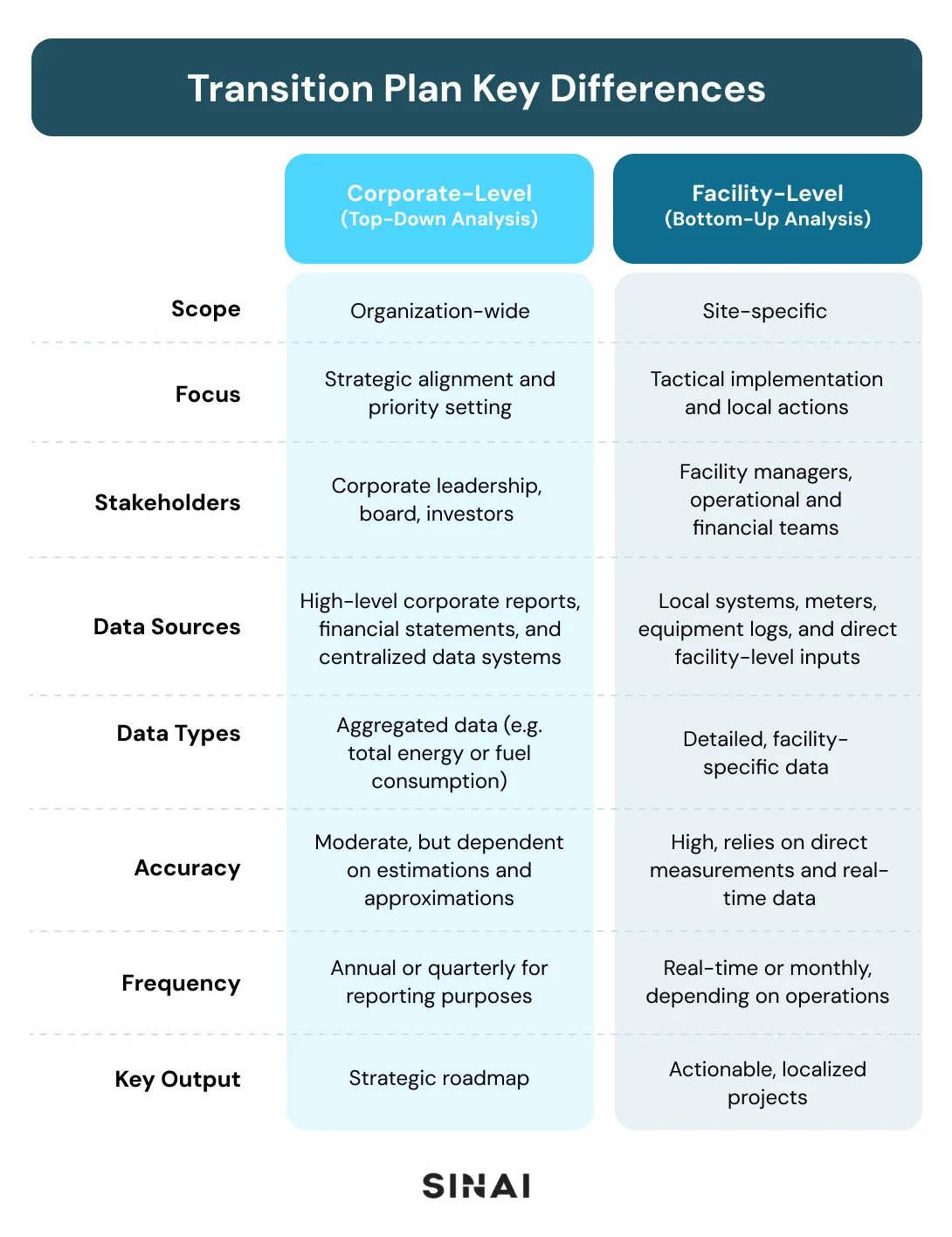
There are differences between corporate-level (top-down analysis) and facility-level (bottom-up) analyses, according to the table below. Despite these differences, corporate and facility-level plans are not mutually exclusive. Instead, they complement each other, creating a seamless bridge between high-level strategy and operational execution.
What's the Best Approach for my Company
Top-Down Approach
- You’re defining your organization’s sustainability strategy for the first time.
- Regulatory compliance or investor requirements mandate a corporate-wide disclosure. Ideal when the goal is to align with global frameworks like SBTi, TCFD, or CSRD.
- You need to set overarching targets and prioritize resources strategically.
- It is useful for creating a unified narrative for stakeholders, such as investors, regulators, and customers.
- Corporates with limited resources may start with a corporate-level plan, requiring less granular data and fewer immediate investments in site-specific tools.
Bottom-Up Approach
- Facility-level data is readily available, and immediate action is required to address high emissions or inefficiencies.
- Your organization has mature sustainability goals and needs to translate them into actionable projects.
- When the priority is operational execution, identifying specific projects, or achieving tangible emissions reductions at the facility level.
- Specific facilities or operations are facing localized regulatory pressures or high operational costs.
- Organizations with the budget and technology for facility-level data collection can prioritize this approach to gain deeper insights and implement localized actions.
Conclusion
Corporations decide between a top-down and bottom-up approach based on their goals, data availability, and resources. A top-down approach is ideal for setting corporate-wide targets, aligning with global regulations, and prioritizing strategic initiatives. In contrast, a bottom-up approach focuses on detailed, facility-specific actions to achieve tangible emissions reductions. Many organizations start with top-down planning to establish a framework and then integrate bottom-up analysis for localized execution, ensuring alignment between strategy and operations. In summary:
- Top-Down Data: Offers a strategic overview to set organization-wide goals and prioritize areas for focus.
- Bottom-Up Data: Provides the detailed, actionable insights necessary to execute those strategies effectively at the facility level.
Many companies may adopt a hybrid approach, starting with a top-down strategy to set corporate-wide goals and then implementing bottom-up plans to achieve those targets at the facility level. This ensures alignment between strategic objectives and operational realities, creating a cohesive and actionable sustainability roadmap.
By integrating both approaches, organizations can ensure their decarbonization efforts are strategically aligned and operationally grounded, creating a more comprehensive and effective transition plan and, ultimately, achieving their emission reduction targets and properly transitioning to a low-carbon economy.




%20(1).png)

'%3e%3cg id='Final-Copy-2_2_' transform='translate(1275.000000, 200.000000)'%3e%3cpath class='st0' d='M7.4,12.8h6.8l3.1-11.6H7.4C4.2,1.2,1.6,3.8,1.6,7S4.2,12.8,7.4,12.8z'/%3e%3c/g%3e%3c/g%3e%3c/g%3e%3cg id='final---dec.11-2020'%3e%3cg id='_x30_208-our-toggle' transform='translate(-1275.000000, -200.000000)'%3e%3cg id='Final-Copy-2' transform='translate(1275.000000, 200.000000)'%3e%3cpath class='st1' d='M22.6,0H7.4c-3.9,0-7,3.1-7,7s3.1,7,7,7h15.2c3.9,0,7-3.1,7-7S26.4,0,22.6,0z M1.6,7c0-3.2,2.6-5.8,5.8-5.8 h9.9l-3.1,11.6H7.4C4.2,12.8,1.6,10.2,1.6,7z'/%3e%3cpath id='x' class='st2' d='M24.6,4c0.2,0.2,0.2,0.6,0,0.8l0,0L22.5,7l2.2,2.2c0.2,0.2,0.2,0.6,0,0.8c-0.2,0.2-0.6,0.2-0.8,0 l0,0l-2.2-2.2L19.5,10c-0.2,0.2-0.6,0.2-0.8,0c-0.2-0.2-0.2-0.6,0-0.8l0,0L20.8,7l-2.2-2.2c-0.2-0.2-0.2-0.6,0-0.8 c0.2-0.2,0.6-0.2,0.8,0l0,0l2.2,2.2L23.8,4C24,3.8,24.4,3.8,24.6,4z'/%3e%3cpath id='y' class='st3' d='M12.7,4.1c0.2,0.2,0.3,0.6,0.1,0.8l0,0L8.6,9.8C8.5,9.9,8.4,10,8.3,10c-0.2,0.1-0.5,0.1-0.7-0.1l0,0 L5.4,7.7c-0.2-0.2-0.2-0.6,0-0.8c0.2-0.2,0.6-0.2,0.8,0l0,0L8,8.6l3.8-4.5C12,3.9,12.4,3.9,12.7,4.1z'/%3e%3c/g%3e%3c/g%3e%3c/g%3e%3c/g%3e%3c/svg%3e)