
.jpg)
.jpg)
Utility Automation: From Utility Bills to Audit-Ready Emissions Data
Ready to shift from compliance to competitive advantage?
Book a demo and see how SINAI can help you streamline data, meet requirements, and build stakeholder trust.

Many enterprises experience the same weak point when producing annual emissions inventories: utility data.
Electricity, gas, water, waste. Together, they span all three scopes. Each one arrives on a different billing cycle, in a different format, and even in different languages. Across dozens or hundreds of facilities, the manual work of collecting, cleaning, and entering that data every quarter adds up fast, and the room for error adds up with it.
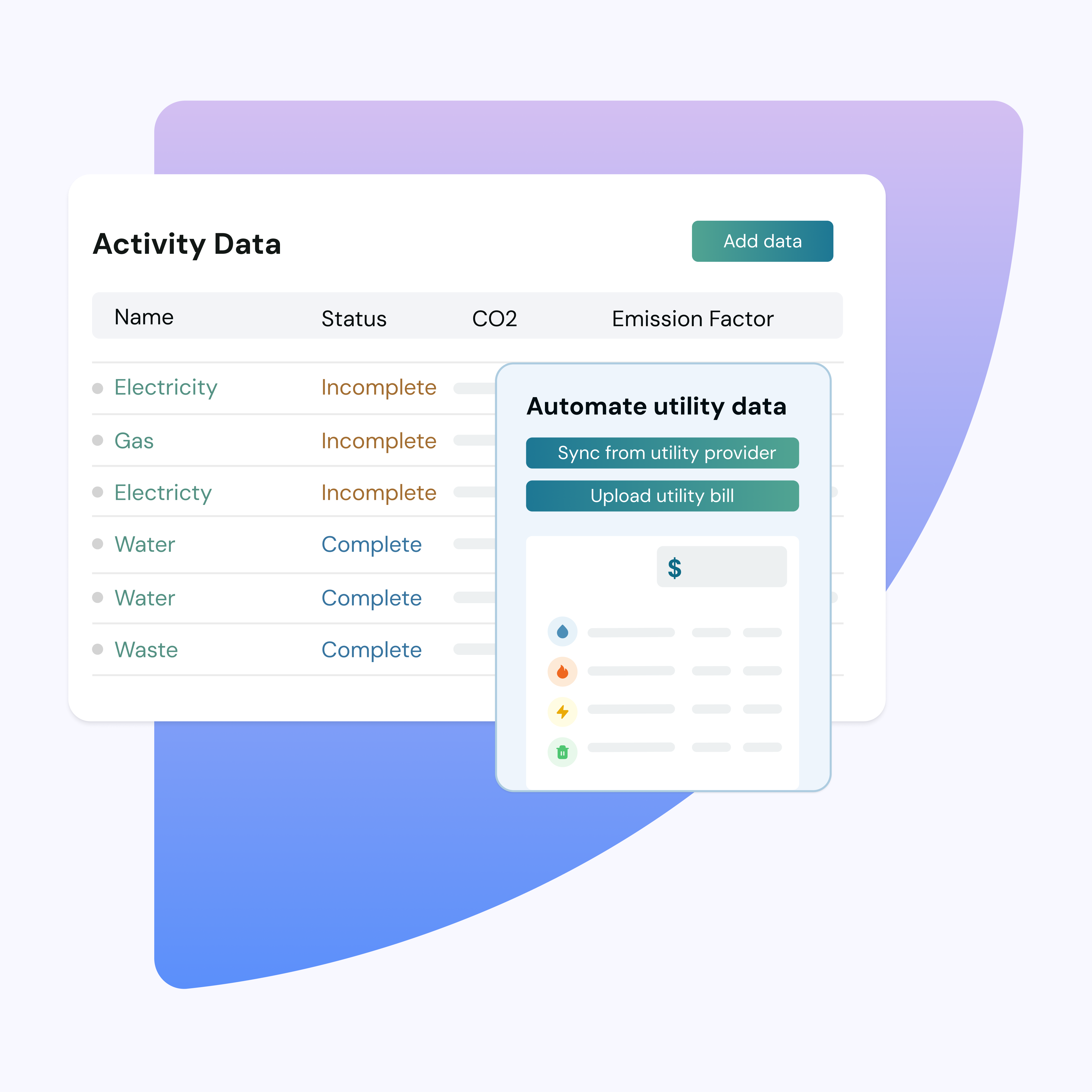
SINAI's Utility Automation removes that bottleneck. Consumption data flows directly from utility providers’ website or PDF invoices into the inventory, mapped to the right scope, facility, and entity as bills arrive.
How SINAI’s Utility Automation Works
There are two ways to connect:.
- Direct provider integration pulls consumption data from utility websites regularly, without having to remember which bills were already downloaded..
- PDF bill upload handles everything else. If you can’t access your utility provider directly, bills uploaded as PDFs undergo the same automated mapping process.
Both paths produce the same output: structured, calculation-ready activity data with a clear audit trail with a link to the original document. In between, SINAI's AI Emissions Match engine and Data Match Agents perform analyst-level work: reading each line item, selecting the appropriate emission factor, and assigning it to the correct business entity.
Built for Enterprise Complexity
Managing utility data across a large organization is not just a volume problem. It is a data integrity problem. Account numbers that do not map to reporting entities, invoices that arrive after the reporting window, and dual reporting or renewable energy data that get lost. These are the details that create gaps in inventories that look complete on the surface. Utility Automation is built for tackling this complexity. One enterprise aviation customer has connected more than 1,500 meters this way, with full audit traceability maintained from each original bill to the final emissions record.
Why Utility Data Quality Is a Compliance Differentiator
Regulatory requirements for emissions data are shifting in different ways across different jurisdictions. The EU's Omnibus package has adjusted the scope of the CSRD. California's SB 253 extends disclosure requirements across the United States. The specific obligations vary, but the underlying standard does not: data needs to be accurate, traceable, and defensible when a third party reviews it.
For a full overview of what the current regulatory landscape requires across jurisdictions, download SINAI's Enterprise Guide to ESG Compliance in 2026.
From Bills to Decisions
Jess Waldeck, CEO of SINAI Technologies: "Utility data is where decarbonization quietly stalls. Teams lose weeks every quarter turning bills into defensible numbers, and Utility Automation does that work for them while showing exactly how every figure was derived, so the focus shifts from collecting data to acting on it."
Utility Automation sits inside SINAI's broader enterprise carbon management platform. Multi-entity inventory structures, audit trails, methodology governance, compliance reporting, and decarbonization planning in one place, built for the complexity large enterprises face and the assurance standards they are increasingly held to.
Take an interactive tour or request a demo to see how it fits your carbon management environment.



-2.png)



'%3e%3cg id='Final-Copy-2_2_' transform='translate(1275.000000, 200.000000)'%3e%3cpath class='st0' d='M7.4,12.8h6.8l3.1-11.6H7.4C4.2,1.2,1.6,3.8,1.6,7S4.2,12.8,7.4,12.8z'/%3e%3c/g%3e%3c/g%3e%3c/g%3e%3cg id='final---dec.11-2020'%3e%3cg id='_x30_208-our-toggle' transform='translate(-1275.000000, -200.000000)'%3e%3cg id='Final-Copy-2' transform='translate(1275.000000, 200.000000)'%3e%3cpath class='st1' d='M22.6,0H7.4c-3.9,0-7,3.1-7,7s3.1,7,7,7h15.2c3.9,0,7-3.1,7-7S26.4,0,22.6,0z M1.6,7c0-3.2,2.6-5.8,5.8-5.8 h9.9l-3.1,11.6H7.4C4.2,12.8,1.6,10.2,1.6,7z'/%3e%3cpath id='x' class='st2' d='M24.6,4c0.2,0.2,0.2,0.6,0,0.8l0,0L22.5,7l2.2,2.2c0.2,0.2,0.2,0.6,0,0.8c-0.2,0.2-0.6,0.2-0.8,0 l0,0l-2.2-2.2L19.5,10c-0.2,0.2-0.6,0.2-0.8,0c-0.2-0.2-0.2-0.6,0-0.8l0,0L20.8,7l-2.2-2.2c-0.2-0.2-0.2-0.6,0-0.8 c0.2-0.2,0.6-0.2,0.8,0l0,0l2.2,2.2L23.8,4C24,3.8,24.4,3.8,24.6,4z'/%3e%3cpath id='y' class='st3' d='M12.7,4.1c0.2,0.2,0.3,0.6,0.1,0.8l0,0L8.6,9.8C8.5,9.9,8.4,10,8.3,10c-0.2,0.1-0.5,0.1-0.7-0.1l0,0 L5.4,7.7c-0.2-0.2-0.2-0.6,0-0.8c0.2-0.2,0.6-0.2,0.8,0l0,0L8,8.6l3.8-4.5C12,3.9,12.4,3.9,12.7,4.1z'/%3e%3c/g%3e%3c/g%3e%3c/g%3e%3c/g%3e%3c/svg%3e)