What Finance Needs to Approve a Reduction Project
Ready to shift from compliance to competitive advantage?
Book a demo and see how SINAI can help you streamline data, meet requirements, and build stakeholder trust.

A Reduction Project Is Not Yet a Finance-Ready Investment Case
A verified emissions reduction target is not enough to secure funding. To become finance-ready, a decarbonization proposal must speak the language of capital allocation: cash flow timing, risk sensitivity, a clear business-as-usual baseline, and assigned operational accountability. Translating technical carbon impact into an actionable investment case means defining the exact decision Finance is being asked to make and modeling its returns, including NPV, IRR and payback, before implementing a project or finalizing your decarbonization strategy.
A team responsible for sustainability or operations might know precisely how much CO2e a project is able to reduce, having identified the technology, verified its technical potential, and confirmed that it aligns with the company's decarbonization roadmap. However, finance will still have its own set of questions.
How much cash goes out? When? What financial value comes back? Which assumptions determine the return? What happens if those assumptions change? Who owns delivery once the capital is approved?
A finance-ready decarbonization project business case connects verified operational assumptions and emissions impact to the same cash-flow, return, risk, and accountability framework the company uses to allocate capital elsewhere.
That is the case when capital allocation is a top finance priority. According to Deloitte's 2026 research, 33% of surveyed finance leaders named optimizing capital allocation and investment decisions as a priority through fiscal 2027.
In practice, this means a technically sound carbon-reduction initiative must be presented as an investment case Finance can evaluate.
Start With the Decision Finance Is Being Asked to Make
A reliable NPV, IRR and payback analysis starts with a clearly defined investment.
Finance must know precisely what the company is being asked to fund; this begins with defining the project boundary, which involves the equipment to be replaced, the process to be modified, the facility to be upgraded, or the operating practice to be changed, and the affected site, assets, business units, and implementation period should all be clearly stated.
First, establish the business-as-usual baseline. If the company decides not to move forward, what will be the operational and financial outcome? The company could keep using the existing equipment, maintenance expenses could rise, production constraints could remain, or replacement capital expenditure might be needed anyway. This baseline serves as the basis against which the project's economics should be assessed.
The approval request must also include a clear timeline: the proposed implementation date, expected operating duration, funding required at this stage, and any further investment phases. If a project depends on an upgrade to another facility, a procurement decision, a shutdown window, or an infrastructure investment, Finance must confirm the dependency before approving.
Ownership should also be included within the investment boundary; a project lacking an accountable business owner may produce an attractive spreadsheet but will still fail to deliver the benefits that have been modeled.
Build the Financial Model From Inputs Finance Can Verify
The quality of a decarbonization business case depends heavily on the traceability of its inputs. Finance should be able to understand where each material assumption came from and who validated it.
CAPEX and Implementation Costs
Begin with the total cost of bringing the project into operation.
Equipment cost is only one element. Depending on the project scope, CAPEX can also cover:
- Engineering and design
- Installation
- Permitting
- Construction
- Integration
- Commissioning
- Infrastructure upgrades
- Contingency
- Costs associated with internal material implementation
Timing matters as much as the total. A $5 million investment paid entirely in year one has different economics from a $5 million program deployed across several years. The financial model should show when each material cash outflow occurs and distinguish committed costs from estimates where appropriate.
Cost assumptions should also be supported by evidence; instead of a single unbacked CAPEX figure, Finance has more to base its assessment on if the assumptions come from a vendor proposal, an engineering estimate, a historical project benchmark, or an approved internal cost standard.
Where the company’s normal capital process requires tax effects, working capital, depreciation, or residual value, those inputs should follow the same methodology used for other investments.
OPEX Changes and Recurring Costs
A reduction project can lower some operating costs while increasing others.
An electrification project, for example, may reduce fuel consumption while increasing electricity consumption. New equipment may reduce maintenance costs but introduce a service contract or software expense. Process changes can affect labor, consumables, utilities, or replacement cycles.
The business case must include the incremental operating effect attributable to the project. That means comparing projected OPEX with the business-as-usual baseline rather than giving the future project cost by itself.
This distinction prevents one of the most common modeling problems: assigning savings to the project that would have occurred anyway.
Savings, Revenue, and Avoided Costs
The value side of the model requires the same discipline.
Energy and fuel savings are often relatively direct when consumption changes can be quantified against a defined baseline. Maintenance savings can also be credible when supported by asset history or engineering assumptions.
Productivity improvements, throughput gains, avoided carbon costs, grants, incentives, and incremental revenue can strengthen the case, but each should have a defensible causal link to the project.
Avoid monetizing every sustainability benefit simply because it strengthens the headline ROI. Finance needs to know whether the claimed value is attributable, evidenced, and auditable.
Strategic value can still matter. It should simply be distinguished from modeled cash flow. A project may improve resilience, reduce exposure to a constrained fuel source, or support customer requirements without turning those benefits into invented revenue.
Timing and Project Life
Investment economics are highly sensitive to when costs and benefits occur.
The financial model should account for implementation timing, ramp-up, useful life, recurring savings, major maintenance events, equipment replacements, and material residual or decommissioning value.
If savings begin six months after commissioning, model that delay. If performance ramps over two years, do not model full savings from day one.
Timing is particularly important for NPV because financial value depends on when cash flows occur, not simply on their cumulative total.
Show Finance the Metrics It Uses to Compare Investments
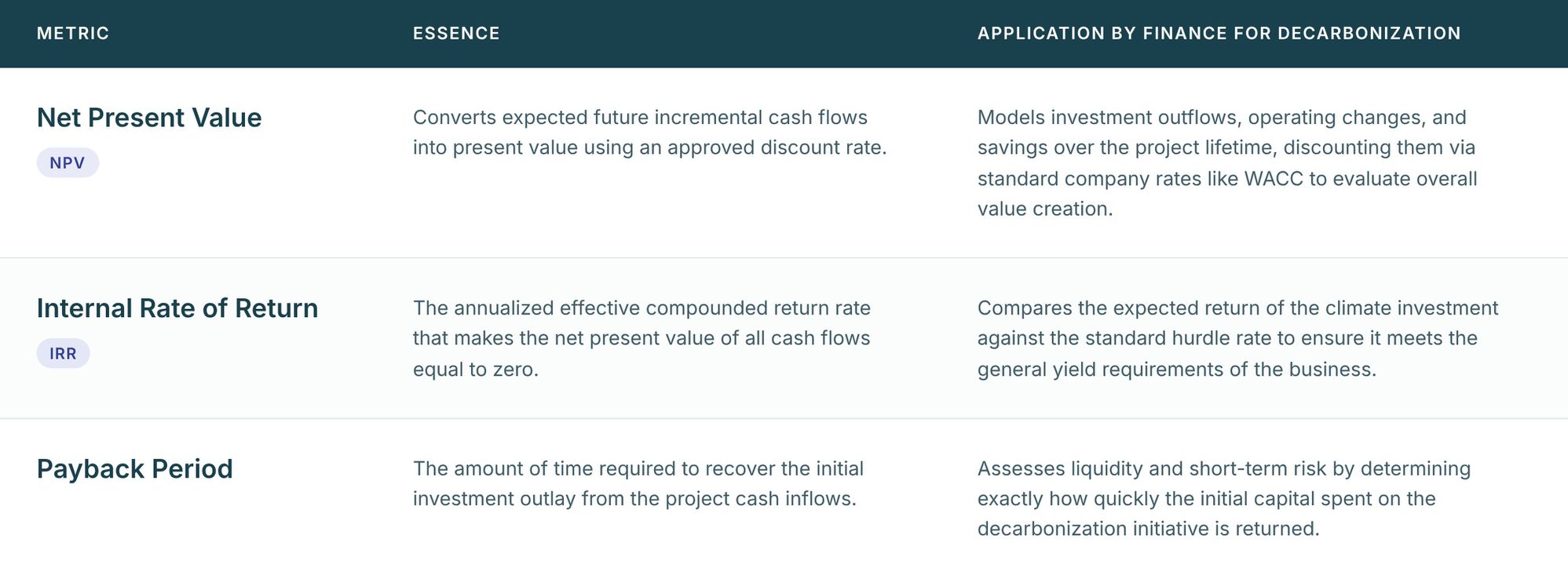
The business case for decarbonization that is prepared by a CFO should be compatible with the company's present capital-appraisal framework.
The goal is to express each climate project in the same metrics Finance already uses to allocate capital.
Internal Rate of Return
The discount rate that causes the project's NPV to be zero is the IRR.
It gives Finance another way to evaluate return, particularly against internal hurdle rates or alternative capital uses. It should be presented alongside the underlying cash-flow profile.
IRR is most useful when read alongside investment size, project life, risk, operational dependencies, strategic fit and the company’s capital rules.
Payback Period
The payback period of the decarbonization project indicates the length of time needed for the cumulative benefits of the project to recover the original investment.
Its simplicity makes it useful for expressing capital recovery and liquidity exposure. Because simple payback ignores value generated after the payback date and the time value of money, present it alongside NPV.
If Finance uses discounted payback, calculate it according to the company’s standard methodology rather than substituting it for simple payback without explanation.
Other Company-Required Metrics
Many organizations likewise ask for the ROI, the profitability index, the earnings impact, the free cash flow, or other measures that are specific to the business unit.
Use them when they are part of the established approval process.
The most effective financial approval for decarbonization projects is achieved by incorporating climate investments within the present financial governance system, rather than establishing a separate definition of what constitutes an attractive investment.
SINAI Reduce is designed around this connection, bringing project-level CAPEX, OPEX, savings, cash flow, NPV, IRR, payback, emissions, scenarios, and prioritization into the same modeling environment.
Model decarbonization projects with NPV, IRR and payback
Connect Financial Return to Carbon Impact
A project aimed at decarbonization has to demonstrate what occurs to the emissions.
For every investment, determine the expected annual reduction in emissions and, if appropriate, the total reduction over the lifetime. You should record the emissions baseline, the assumptions used in the calculation, when the implementation takes place, and the operational factors that influence the amount of emissions reduced.
The cost per tCO2e can provide another useful criterion for making decisions. The methodology should be clearly defined and finance and sustainability should know whether the calculation is based on annual or lifetime abatement and which project costs, savings, and discounting assumptions are taken into account.
The cost per tonne and the financial return address different questions; it is possible for a project to achieve considerable emissions reductions even if the financial returns are weak, and in another case the carbon impact may be fairly small yet attractive operating savings can be generated.
By keeping both dimensions visible, the company can make that trade-off on purpose.
When comparing portfolios, a marginal abatement cost curve can enable teams to see how the various projects differ in terms of cost and abatement potential without requiring them to turn the individual project business case into a MACC exercise.
Compare reduction projects with a marginal abatement cost curve
Stress-Test the Assumptions Before Finance Does
A base case presents one possible future. Finance needs to understand how resilient the economics are when reality differs from the plan.
Start by identifying the small number of assumptions that materially drive the result. Depending on the project, those could include:
- Energy or fuel prices
- CAPEX
- Implementation timing
- Equipment performance
- Utilization
- Production volume
- OPEX
- Useful life
- Incentives
- Financially relevant carbon price
Then model at least three coherent scenarios: base case, downside case, and upside case.
The downside scenario should be based on credibility rather than being deliberately catastrophic. If capital expenditure rises, commissioning is delayed, energy prices move adversely, or the equipment turns out to deliver fewer savings than expected, what effect does this have on the NPV, IRR, and payback?
The discussion becomes even more useful as a result of a break-even analysis. Finance will be able to determine the greatest amount by which CAPEX can overrun its budget, the energy price needed to achieve a certain hurdle rate, or the utilization level at which the investment no longer meets the company's criteria.
Internal carbon pricing may also be introduced where it actually plays a role in company decision-making. According to the World Bank's 2025 State and Trends of Carbon Pricing report, organizations are increasingly using internal carbon prices to manage climate-related risks and to inform their capital investment decisions.
Where carbon pricing is used, make the price and escalation assumptions transparent. Treat them as scenario inputs unless the company has established rules for including them directly in project cash flows.
Show That the Project Is Executable, Not Just Profitable on Paper
Investment approval depends on confidence that the modeled value can actually be delivered.
Finance needs to know who owns the project, whether the technology has been validated, how the costs were worked out, when implementation can start, and what operational dependencies might affect the outcome.
The proposal must also specify the material risks together with the measures to address them; changes to vendor availability, production disruption, permitting, grid connections, equipment performance, internal capacity, and implementation timing can all have an effect on the economics.
Then define how benefits will be verified after commissioning.
Who is going to compare the actual energy consumption with the baseline? Who will verify the savings that have been achieved? How are the emissions reductions to be calculated? And when will the project be examined in relation to its original business case?
This closes the loop between capital approval and performance accountability.
That workflow is at the heart of SINAI Reduce's approach; its product framework progresses from opportunity discovery and financial modeling through to ownership, approvals, project implementation, and verification against the emissions, energy, and financial targets.
The same principle appears in customer deployment. SINAI’s materials report that Wilson Sons modeled more than 600 facility-level reduction levers, while Minerva Foods used scenario modeling and financial feasibility analysis to build a dynamic project database.
The Finance-Ready Reduction Project Checklist
Before asking for capital approval, the decarbonization project business case should answer:
- Project definition: What are we changing, where will it happen, when will it be implemented, and what is its expected operating life?
- Baseline: What happens financially and operationally if the project does not proceed?
- Investment: What CAPEX and implementation funding are required, and when will the cash outflows occur?
- Operating economics: What incremental OPEX changes, savings, avoided costs, or defensible revenue will result?
- Cash flow: What are the incremental cash flows over the full project life?
- Financial metrics: What are the NPV, IRR, payback, and other metrics required by the company’s capital process?
- Carbon impact: How many tCO2e will the project reduce, over what period, and against which baseline?
- Assumptions and sensitivity: Which variables materially drive the economics, and does the investment still meet the relevant criteria under a credible downside case?
- Risk and execution: What could prevent the modeled benefits from being delivered, how will those risks be managed, and who is accountable?
- Capital-allocation context: How does this project compare with other uses of the company’s capital?
From a Reduction Project to a Finance-Ready Investment
It is easier to assess a reduction opportunity when Finance does not have to put it into investment terms.
Take the project to the capital discussion having established a clear baseline, with assumptions that can be traced, incremental cash flows, NPV, IRR, payback, carbon impact, sensitivity analysis, execution risks, and specific people responsible. In this way, Finance will have the information it needs to assess the project in the way that is normal for the company's investment process while ensuring that the emissions outcome remains visible.
It then establishes a more rigorous operating discipline once approval has been given. The assumptions employed to obtain capital then serve as the standards against which implementation and actual performance can be assessed.
SINAI Reduce provides full lifecycle support, covering facility-level reduction project modeling and the preparation of business cases that are ready for financial evaluation, as well as scenario comparison, ownership arrangements, performance tracking, and verification. The financial features include CAPEX, OPEX, savings, NPV, IRR, payback, and cash flow, together with carbon metrics.
Convert reduction opportunities into business cases that are ready for finance with SINAI Reduce.








'%3e%3cg id='Final-Copy-2_2_' transform='translate(1275.000000, 200.000000)'%3e%3cpath class='st0' d='M7.4,12.8h6.8l3.1-11.6H7.4C4.2,1.2,1.6,3.8,1.6,7S4.2,12.8,7.4,12.8z'/%3e%3c/g%3e%3c/g%3e%3c/g%3e%3cg id='final---dec.11-2020'%3e%3cg id='_x30_208-our-toggle' transform='translate(-1275.000000, -200.000000)'%3e%3cg id='Final-Copy-2' transform='translate(1275.000000, 200.000000)'%3e%3cpath class='st1' d='M22.6,0H7.4c-3.9,0-7,3.1-7,7s3.1,7,7,7h15.2c3.9,0,7-3.1,7-7S26.4,0,22.6,0z M1.6,7c0-3.2,2.6-5.8,5.8-5.8 h9.9l-3.1,11.6H7.4C4.2,12.8,1.6,10.2,1.6,7z'/%3e%3cpath id='x' class='st2' d='M24.6,4c0.2,0.2,0.2,0.6,0,0.8l0,0L22.5,7l2.2,2.2c0.2,0.2,0.2,0.6,0,0.8c-0.2,0.2-0.6,0.2-0.8,0 l0,0l-2.2-2.2L19.5,10c-0.2,0.2-0.6,0.2-0.8,0c-0.2-0.2-0.2-0.6,0-0.8l0,0L20.8,7l-2.2-2.2c-0.2-0.2-0.2-0.6,0-0.8 c0.2-0.2,0.6-0.2,0.8,0l0,0l2.2,2.2L23.8,4C24,3.8,24.4,3.8,24.6,4z'/%3e%3cpath id='y' class='st3' d='M12.7,4.1c0.2,0.2,0.3,0.6,0.1,0.8l0,0L8.6,9.8C8.5,9.9,8.4,10,8.3,10c-0.2,0.1-0.5,0.1-0.7-0.1l0,0 L5.4,7.7c-0.2-0.2-0.2-0.6,0-0.8c0.2-0.2,0.6-0.2,0.8,0l0,0L8,8.6l3.8-4.5C12,3.9,12.4,3.9,12.7,4.1z'/%3e%3c/g%3e%3c/g%3e%3c/g%3e%3c/g%3e%3c/svg%3e)